For decades, drivers alongside Interstate 95 through Liberty County have passed thousands of acres of timberland, marsh and waterfront property without knowing what was in store for the miles of undeveloped coastline.
Now, a 5,000-acre master-planned community is underway near Midway’s Exit 76. The Laurel View development promises new housing, commercial investment, public waterfront access and recreational opportunities. County leaders say the project will be transformative, diversifying both the county’s housing market and economy.
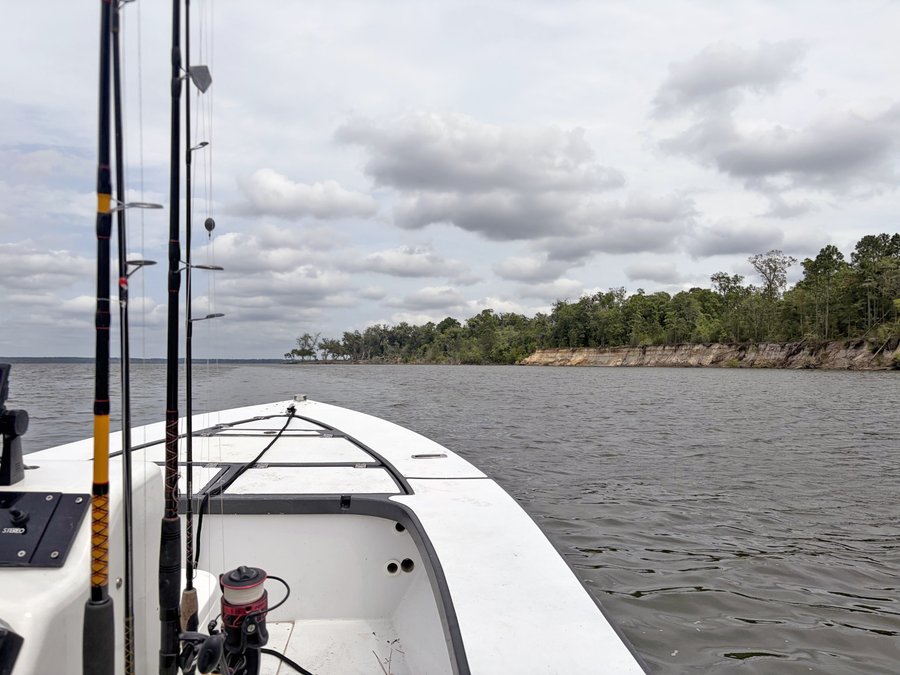
The property includes marsh and deepwater frontage along Jones Creek and the Laurel View River, plus about one mile of frontage along Interstate 95. Developers estimate the project will ultimately include 2,700 to 3,000 homes built over about 15 years, along with commercial centers, recreational amenities, waterfront gathering spaces and a marina village.
Liberty County Commission Chairman Donald Lovette compared the development’s potential impact to the arrival of Fort Stewart.
“I can see the impact being the same — it’ll be a great catalyst for Liberty County,” he said. “It’ll be a game changer for this community, economically, residentially and recreationally.”
Decades in the making
While Laurel View may appear to be arriving amid a regional development boom, the project has been in the works for nearly 25 years.
Travis Stringer, the Foram Group’s CEO, said the land has been owned by the southeastern U.S.-based real estate group and its partners since the late 1990s. The site began as roughly 5,400 acres. Portions of that land became Tradeport East, a Liberty County Development Authority-owned business and industrial site and the Dorchester Shooting Preserve.
“Four years ago, we sold it to a partnership of members, including Dorchester … to preserve that land for that hunting operation into perpetuity for their future,” Stringer said.
Stringer said in the early 2000s, plans called for a much larger residential community stretching south toward Sunbury. Development was tied to a new wastewater treatment facility in the area. However, those plans stalled during the 2008 financial crisis.
“The county’s water and sewer project started and then stopped, and so did ours,” Stringer said.
Today, the focus is on about 1,800 acres, with roughly half of the site’s 10 miles of river and marsh frontage preserved.
“This is really our third attempt at getting this off the ground,” Stringer said.
A new kind of community
Unlike traditional subdivisions, Laurel View is a master-planned community where residents can live, work, shop and recreate in the same area.
The project will include single-family homes, townhomes, apartments and potentially active-adult housing. Entry-level homes are expected to start in the high $200,000 range, with prices increasing toward the waterfront. Developers are even getting creative with density and housing sizes along the marsh to create affordability and accessibility.
Stringer said the goal is to create a neighborhood that accommodates residents at different stages of life and income levels.
“With these mix of price points and product types, we’re really trying to build this community where … ultimately you grow into this neighborhood,” Stringer said. “Your kids grow up in this neighborhood, and they want to come back to it.”
Commercial development near the interchange will serve as the anchor. Developers envision a 150-acre mixed-use village with retail, restaurants, offices, hotels, medical facilities and about 300 multifamily units.
Stringer said the concept differs from the typical highway interchange development seen elsewhere along Interstate 95. Rather than focusing solely on gas stations or “big box” products, the vision is for a walkable commercial district that serves both residents and visitors.
“We’re really trying to create a lifestyle,” Stringer said. “Once you come to your house and park your car in your garage, you can get on a golf cart, your bicycle or walk and get all your basic daily and weekly services and experiences.”
County leaders emphasized the development’s commercial investments. Fort Stewart has served as the county’s primary economic engine for generations.
“If we can get more private sector jobs and/or residents who don’t depend directly on Fort Stewart for their income, it’ll diversify our economy and make us a little more resilient toward any future changes that might happen at Fort Stewart,” Liberty Consolidated Planning Commission Executive Director Jeff Ricketson said.
Lovette believes the project could help diversify Liberty County’s economy while creating amenities residents currently travel elsewhere to access. It also will simply bring commercial development to an area that Lovette said is currently lacking.
“We need commercial in that area,” he said.
‘Working in the natural landscape’
Perhaps the most distinctive feature of Laurel View is its relationship to the coast and its commitment to preserving the land.
The property contains miles of waterfront along tidal marshes and rivers, areas that have historically remained inaccessible to the public. Stringer said preserving public access has been a priority from the beginning.
Plans call for a 20-foot public easement along marshfront areas throughout the development. Similar to Savannah’s Bluff Drive on Isle of Hope, the easement would allow residents and visitors to walk portions of the waterfront regardless of who owns adjacent homes.
The project also includes plans for a marina village, community docks and boat-launch facilities.
“What I like most is it’s going to ensure the general public will have access to the riverfront property,” Lovette said. “We’ll have our own little Savannah River Street.”
Despite the scale of the development, Laurel View’s developers emphasize preservation as a central component of the project. Stringer estimates that between 40% and 50% of the property will remain undeveloped as green space, wetlands, conservation areas and natural buffers.
“A big focus of ours is not just coming in and clear cutting and mass grading like you see in a lot of other projects,” Stringer said. “We have development standards. We’re really trying to work in the natural landscape.”
Why now
Stringer said interstate connectivity, the Hyundai Motor Group Metaplant America’s coming to the region and Liberty County’s water and sewer capabilities revived the Laurel View development project.
“The Belfast interchange in Heartwood made our property feel close for the first time,” he said. “Then you had the industry … commercial that came in … with all the residential and that connectivity. It kind of took off. We’re five minutes from that interchange. All the stars aligned.”
HMGMA and its ripple-effect job creation also created a push for the project as Laurel View will present opportunities for worker housing.
“Liberty County is actually well positioned because they’re outside of the 30-mile radius requirement for certain suppliers … that come in for Hyundai from a labor competitive standpoint,” Stringer said. “In Tradeport East, they’ve already gotten a Hyundai supplier; more of that is going to come.”
However, development in both Tradeport East and the Laurel View project is dependent on Liberty County reviving the wastewater facility project it had to drop in 2009. Stringer said while the county has existing sewer capacity that will allow construction activity to begin, it’s limited.
“Laurel View is going to be the equivalent of another city,” Ricketson said. “With that development as big as it’s going to be, the water reclamation will have to become a reality wherever it goes.”
The LCDA began furthering the county’s water reclamation facility project in early 2026. However, the project has received backlash from area residents because the facility will be permitted to discharge up to 3 million gallons of treated wastewater into either the Laurel View or North Newport River per day.
Brynn Grant, the LCDA’s CEO, said reusing the water is a project priority and will mean much less water being discharged.
The Laurel View Development is the first “customer” that has committed to reusing that water. It will irrigate the medians along a five-mile-long road and then irrigate green spaces within each of the developed pods. Altogether this could be about 60 acres reusing treated wastewater for irrigation.
Chris Stovall, a Thomas & Hutton engineer, said this could add up to about 150,000 gallons per day during the growing season, from March to October. There could be more irrigation some weeks, and the cooler season would have ¼-1/8th the capacity.
Grant said rates for water reuse haven’t yet been decided.
County leaders say planning for transportation improvements has been underway for years.
Liberty County has begun road expansions, interchange upgrades and utility improvements to support the expected growth. This includes the widening of Islands Highway, future loop connections, traffic distribution and interchange improvements.
“They’re trying to get ahead of the game,” Stringer said.
Long term plan
Construction activity in Laurel View will begin soon.
Stringer said infrastructure work and road improvement and access construction could start as early as July with the first homes becoming available around early 2028.
Even then, Stringer said growth will be gradual.
At full build-out, Laurel View could take 15 years or longer to complete, adding “a couple hundred homes” per year.
“As far as our project’s concerned … it’s slow progressions,” Stringer said. “It’s not 1,000 homes on the ground all at once and then 2,000 people move in and two years later, you blink and everything has been ruined and changed and traffic’s everywhere.”
County officials believe that timeline provides an opportunity for growth to occur in a measured and sustainable way. Ricketson said Liberty County has grown at roughly 1.5% annually over the past two decades.
County planning and zoning staff have been strategic when writing Unified Development Ordinances to “raise the bar” for housing developments. Ricketson said recently adopted UDOs require developers to provide plans for green, communal space.
“In the past, developers would come out and they proposed to get the maximum number of lots they could without providing a lot of additional amenities,” he said. “Now, it raises the bar.”
Now UDOs require provisions for open space and places, such as walking trails, given they have a smaller individual yard, Ricketson added.
Stringer said the Laurel View development will bring a new proof of concept to Liberty County.
“It’s going to create a new proof that this type of product is something that people who live in Liberty County, people who want to move to Liberty County, are looking for,” he said. “I think that’s just going to change the dynamic of Liberty County in a positive way.”