Communities that are looking at becoming home from data centers should learn as much as they can about them, said data center proponents and environmental advocates.
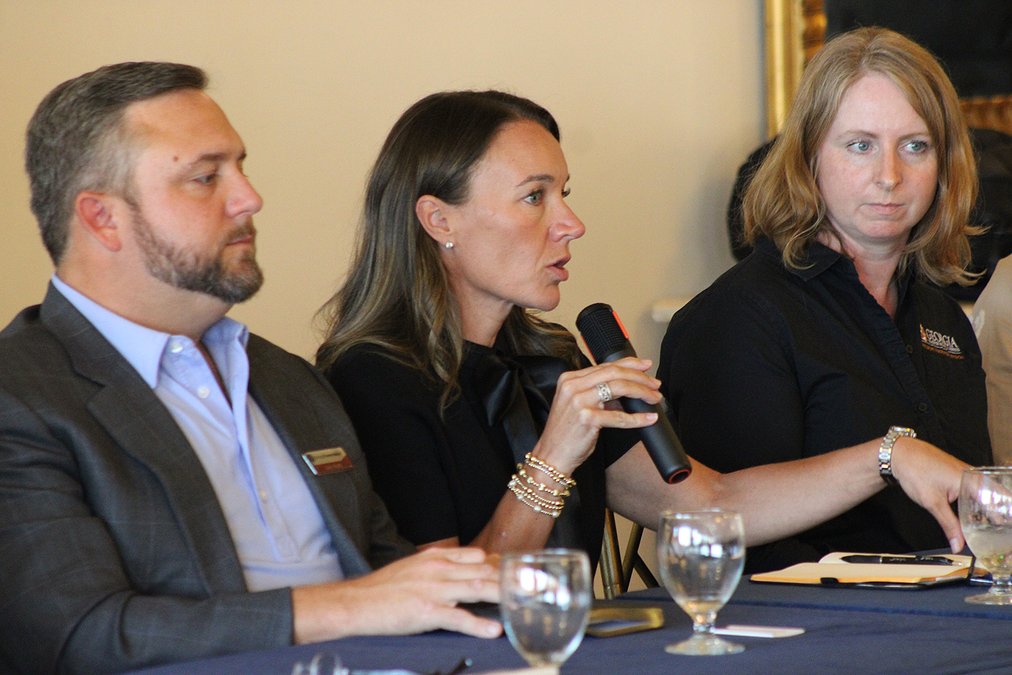
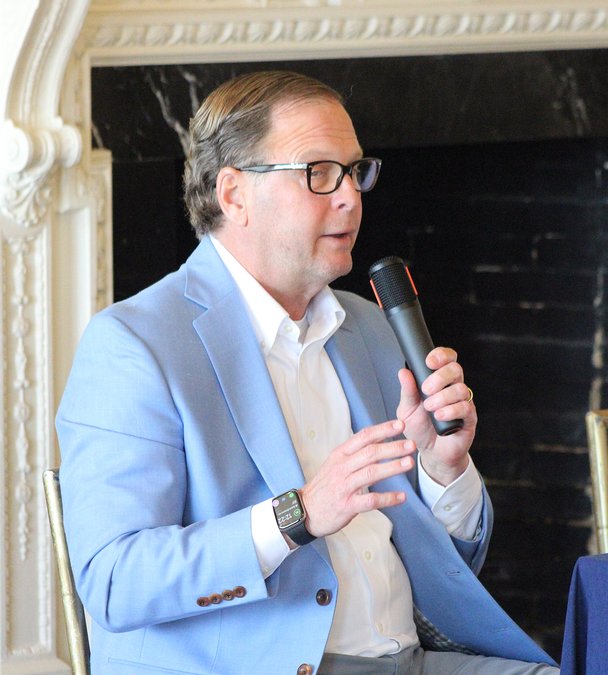
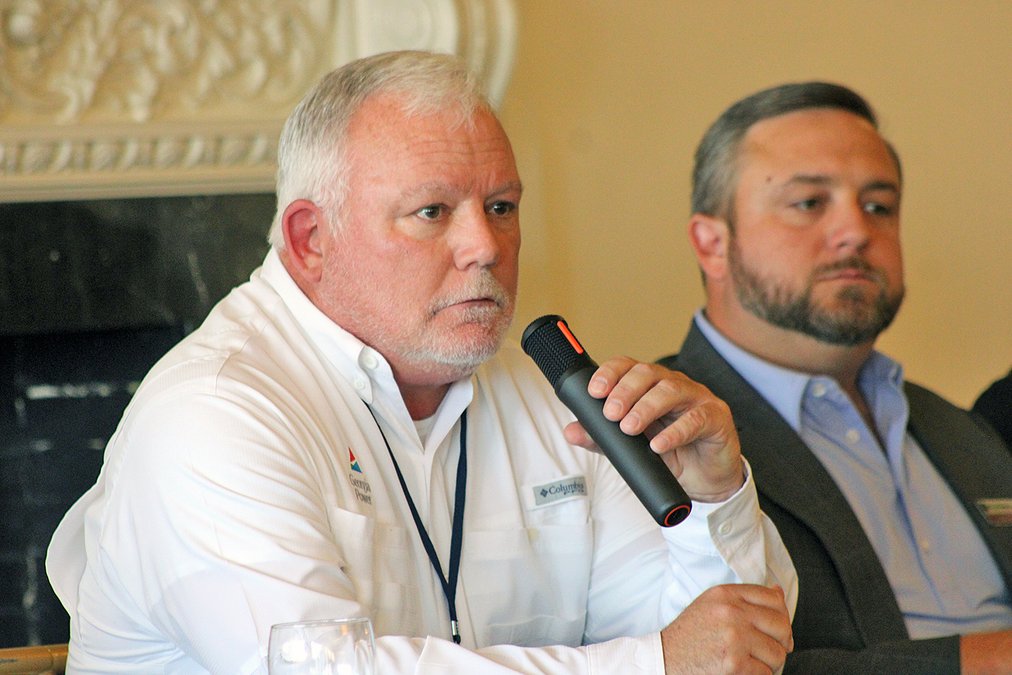
Attendees at the recent Liberty County community planning workshop got a panel discussion on data centers to close the event, including from directors of two development authorities involved with data center projects.
In Fayette County, QTS is building a data center campus, with an initial footprint of more than 600 acres and expects to take up close to 900 acres. After Facebook and Meta chose Newton County sites for its data centers, the Fayette County Development Authority pursued QTS, FCDA CEO Niki Vanderslice acknowledged.
Fayette County, home to a number of people who work at Hartsfield-Jackson International Airport and its airline carriers, has a property tax digest of about $10.5 billion. Of that, 85% is residential.
“So we needed the investment of a data center,” Vanderslice said.
In 2017, Fayette County leaders started looking at the best land use, with using the least amount of land.
“We had excess capacity because of our water system and we started checking off boxes,” Vanderslice said. “We ended up with a phenomenal partner.”
The benefits, in packages and tax rollbacks
QTS purchased the land in 2022 and made an initial investment of $11 billion. Their investment in the community, Vanderslice said, is now approaching $115-$130 billion.
“It is going to present real opportunities for our local officials to provide property tax relief to our homeowners,” she said.
Effingham Industrial Development Authority CEO Brandt Herndon has been in the middle of a firestorm over opposition to Open AI’s planned $20 billion data center in Effingham County.
He brought up the Mike Tyson’s adage — everyone has a plan, until they get punched in the face.
“We thought we were prepared,” Herndon said. “Everybody has a plan until they get punched? Well, with Mike Tyson, nobody got off the mat. We got off the mat.”
The planned Open AI project is going in what is known as the Savannah Gateway Industrial Hub, which is about 2,600 acres. Formerly, it was known as the Research Forest Tract before the IDA acquired about 20 years ago.
The property already carries an industrial zoning and while the IDA owned the land, Broe Real Estate held the development rights. After they brokered the sale to Open AI, they brought the Effingham IDA a $360 million check.
Since the announcement, the Effingham school system has announced a millage rate rollback of 2 mills, the county has announced it is rolling back its millage by 2 mills and the IDA is rolling back its millage rate of 2 mills. The project is putting $90 million in the county’s coffers over three years to roll back taxes.
“We said this is a way to give property tax relief and all we heard is ‘I’ll believe it when I see it,’” Herndon said. “Well, everybody sees we’re doing it.”
State law prohibits the IDA from directly sending the money back to property taxpayers, but they will have between $200$250 million to reinvest in the community.
“That’s incredible,” he said. “That’s just because of the land sale.”
The day before the announcement of Open AI coming to Effingham County was made, the company told county leaders it intended to establish a $20 million community benefits package. The day of the announcement, Herndon added, that pledge went from $20 million to $80 million.
“Open AI wants to be a good citizen,” he said.
With QTS coming to Fayette County and its campus, the Fayette County Development Authority has come off the budgets from the county and the cities. The Effingham IDA, like the Liberty County Development Authority, was set up by a state constitutional amendment, giving it the ability to levy a property tax millage.
The original 650 acres where QTS is going paid $11,000 in property taxes to Fayette County in 2021. This year, just on land value, that tax bill will be $6 million. QTS also has a tenant and for that tenant’s active building, it will pay $58 million.
The boost in property tax revenues also has meant a pay raise for teachers in the Fayette County system, Vanderslice said.
All that equipment to be assessed at tax time does come with a substantial headache, Vanderslice admitted. For one building alone, the Fayette County assessors had to enter 24,000 lines for the equipment.
“Our assessors were not equipped for that,” she said.
Concerns on data centers
Herndon noted the concerns over data centers, and especially in Effingham, where residents have decried the lack of transparency before the announcement.
“People are scared,” he said. “I get that. There is a certain group who aren’t going to believe anything. There is a large portion who do understand and do want to learn more about this opportunity.”
Susan Inman, midcoast advocate for 100 Miles, an organization that is a proponent for the coastal environment, said data centers can bring economic benefits to a community — but there are non-negotiables as far as the group is concerned, especially when it comes to water usage.
“If you’re in a red zone, you should not be building a multi-million gallon utility,” she said. “If you don’t have reliable water at the beginning, how are you going to have longevity?”
The other, Inman said, is location.
“Location matters,” she said. “There are significant impacts to our water and our industrial systems.”
Inman also pointed to the connection between wildlife corridors and communities and Erin Cork, program manager for the state Department of Natural Resources’ Wildlife Resources Division, also called for protecting wildlife corridors.
“You can see how important Liberty County is in connecting some of the most biodiverse areas in the country,” she said. “Fort Stewart has more rare species of plants and animals than almost anywhere in the state.”
While the state DNR is not a major part of the initial planning for data centers, Cork said, the state wildlife action plan should be taken into consideration.
“We would like to see them thinking more about the environmental concerns early on,” she said.
Vanderslice agreed that location matters when it comes to data centers moving into a community. Vanderslice said questions to ask include whether another industrial project would be sited on the proposed location and which company is involved. QTS has committed $3 million for a countywide mapping system and is committed to helping with a municipal fire station.
“QTS has stepped up time and time and time again,” she said.
Open AI is going into a massive tract already zoned for industrial use, and warehouses occupy about one-third of that land.
“It was going to be warehouses,” Herndon said of the land where Open AI intends to locate.
Had it been warehouses instead, the wetlands nearby likely would have been impacted.
“The layout of Open AI is staying out of the wetlands,” Herndon said. “Open AI is being very intentional as to where they are placing these buildings, and that is very important.”
Herndon said the project will have a closed loop system, and Vanderslice added that the data centers’ water needs, after completion, will be minimal. Much of the water, she said, is needed during construction.
“That’s a big misconception,” she said of water usage. “A lot of times, each of those buildings, when constructed, will use the same amount of water as six homes.”
At buildout, that puts the water usage of the entire data center complex at less than 100 homes. If turned into a residential property, the same tract could have 1,800 homes on it, Vanderslice said.
For QTS’ entire complex of around 900 acres, the company has not had to buy a single wetlands mitigation credit, Vanderslice said. They also have put in dust mitigation, with water trucks rinsing off trucks coming in and out of the site as its under construction.
Concerns over low frequency noise also have been lobbied, and Herndon said that is a question they want to answer.
“We’re trying to learn about that,” he said. “We’re modeling that. That’s one of the things we’re going to take a deep dive on in the next several weeks.”
Joey Heath, manager of customer solutions and technology integration for Georgia Transmission Corporation, and Georgia Power regional manager Alan Volskay said providing enough power for the coming data centers shouldn’t be a problem.
Heath said a data center’s proximity to existing transmission will be reviewed. Herndon said one of the reasons Open AI chose Effingham is the nearby Plant McIntosh and how close it is to a transmission corridor.
“An important part of the conversation is to make sure everybody understands, yes, there is some additional infrastructure,” Heath said, “but if we’re doing things the way we’re supposed to, it will be a benefit to the community as well.”
Volskay said Georgia Power’s economic development arm gets involved right away with any data center proposal to see where the best fit would be.
“There are three steps they have to follow before we can do a study on a location,” he said. “It’s going to be exhaustive — how we serve them but also how we continue to serve the surrounding community. In some cases, there is a no, and in some cases, there is a yes.”
Volskay said the large power users have enabled the utility to freeze its rates.
The Kings Bay Sub Base sent a letter to City of Kingsland officials in May questioning a proposed data center proposal and its impacts on water and especially on the electrical grid, since the base has needed redundancies built in for its mission. Volskay said Georgia Power since has told Kings Bay commanders there would be no blackouts and the system will be more robust.
Kingsland City Council eventually enacted a oneyear moratorium on data centers.
Governments and data centers
Inman called for local governments and development authorities to be open about data center plans.
“To have your strongest foundation and strongest path forward is to be transparent and have a well-structured review process,” she said. “A lot of times when the process is brought to the community, the authorities know what is happening, but the residents don’t. They don’t have access to the experts. They don’t know what questions to ask.”
Inman cited Wayne County’s ordinance on data centers as a model for others to follow. Those regulations were put in place back in January and they require an environmental impact assessment, setbacks of 1,000 feet to schools and 1,500 feet to residential areas, assessments on potential energy, stormwater runoff, carbon emissions and water usage and no emissions that include smoke, heat, dust or humidity beyond the property lines.
“To put in an ordinance that puts in guardrails is a smart move,” she said.
Herndon said it took some convincing of a few Effingham leaders, particularly school Superintendent Yancy Ford. He had to assure Ford that the schools would not lose out on their state equalization funding or their Quality Basic Education funds from the state.
“If it wasn’t good for everybody,” Herndon said, “it was good for nobody.”
Three of the Effingham County commissioners who approved the data center request are up for election, but Herndon said they remain solidly behind the plans.
“It’s overwhelming for us. It’s overwhelming for our elected officials,” he said. “They’re under tremendous pressure. They’re stepping up. We’re united. Our board of education, the development authority, we vetted it, we talked about it and everybody is on board and moving forward.”